Support pathways
Incident response guides, caseworker routes and referrals to specialist services.
A community invitation
Muslim organizations and neighbours of every faith, building safer and more connected communities.
Find people to work with, share what your community needs and contribute what you can.
Individuals and organizations welcome.
One signup, followed by a personal onboarding review.
01 / Why a council
A person facing hate, isolation or a difficult moment should be able to find trusted people, useful information and a clear next step.
The Council of Madinah is being developed to bring neighbours, organizations and institutions together around the needs people identify. Muslim organizations are the first audience for this invitation. People of all faiths and backgrounds are welcome.
Our vision
Communities where every person belongs, lives safely and can help shape a better future.
Our mission
Inspired by the Charter of Madinah’s principles of shared responsibility, we connect people, faith communities, organizations and institutions to meet local needs, counter Islamophobia and other forms of hate, and build trust, care and opportunity for all.
In seventh-century Yathrib, now known as Madinah, the Prophet Muhammad and local communities set out shared duties in a document known as the Charter or Constitution of Madinah. Its provisions included mutual protection and the distinct religious identities of Muslim and Jewish groups.
The Council draws inspiration from those responsibilities: keeping commitments, addressing disputes and caring for people who share a place. The present-day Council is a new proposal shaped by the communities taking part.
Historical source: the Charter in A. Guillaume’s translation, especially provisions 25, 37 and 44.
02 / What you can gain
The member offer is being developed. The aim is to help people and small teams find support, prepare together and act on local priorities. Services and partner terms will be confirmed before use.
Incident response guides, caseworker routes and referrals to specialist services.
Local briefs, wider research and clear explanations to share with your community.
Peer introductions, learning circles and local partners with relevant experience.
Templates for schools, media, community engagement and safety planning.
A grant calendar, eligibility checks and help preparing a project with partners.
Preparation for city meetings and a record of commitments to follow up.
Tell us what would help your community.
Sign up03 / Care and connection

Start with what the person needs. Ask permission before connecting them with help.
The proposed Muslim Food Bank and Community Services (MFBCS) caseworker route needs an agreed scope, consent process and confirmed availability before referrals begin. Read about MFBCS’s independent ASPIRE service. The Council signup form is for participation, not personal case details or urgent help.
04 / Countering Islamophobia
Connect care for people with prevention in schools, workplaces, faith sites and public life. Affected communities choose the action; the Council’s proposed role is to connect the people, evidence and partners who can help.
Help someone document a concern, find support and reach an appropriate caseworker or legal service.
Plan open houses, bystander learning and practical support with the people affected.
Share accommodation guides, brief staff and agree a clear response to harassment.
Review risks, prepare volunteers and connect specialist safety advice.
Check harmful claims, explain the evidence and amplify credible Muslim voices.
Bring evidence to decision makers, agree a specific action and track the response.
Use the draft guide to work through safety, consent and the next step.
Read the response guide05 / Working together
Together Everyone Achieves More
Residents describe what needs to change. The group agrees a priority, names who can act and returns to the people who raised it.

Residents describe the need and what would help.
Pick a shared priority. Agree the next step and a lead.
Offer skills, contacts or resources that fit your capacity.
Review what changed. Share what worked and what did not.
06 / Funding and capacity
The proposed funding support helps teams decide what fits their mission, prepare together and learn from each application.
Match dated opportunities to place, purpose and eligibility.
A useful shortlistCheck the deadline, workload and fit with your mission.
A pursue or pass decisionBring partners, a budget, evidence and a shared plan together.
A credible project planReview the application and use feedback in the next attempt.
A stronger next applicationThis support is in development. Funding decisions remain with funders; awards and introductions are not guaranteed.
07 / Learning resources
Draft guides for community conversations, staff learning, school visits and local action. Each guide links to its sources and includes a practical next step.

Understand
Beliefs and everyday practice, common questions and respectful discussion.
Read the guide
Connect
Introductions to faith communities, visiting with care and planning a shared gathering.
Plan a conversation
Act
Recognize different kinds of harm, choose a suitable response and use a planning worksheet.
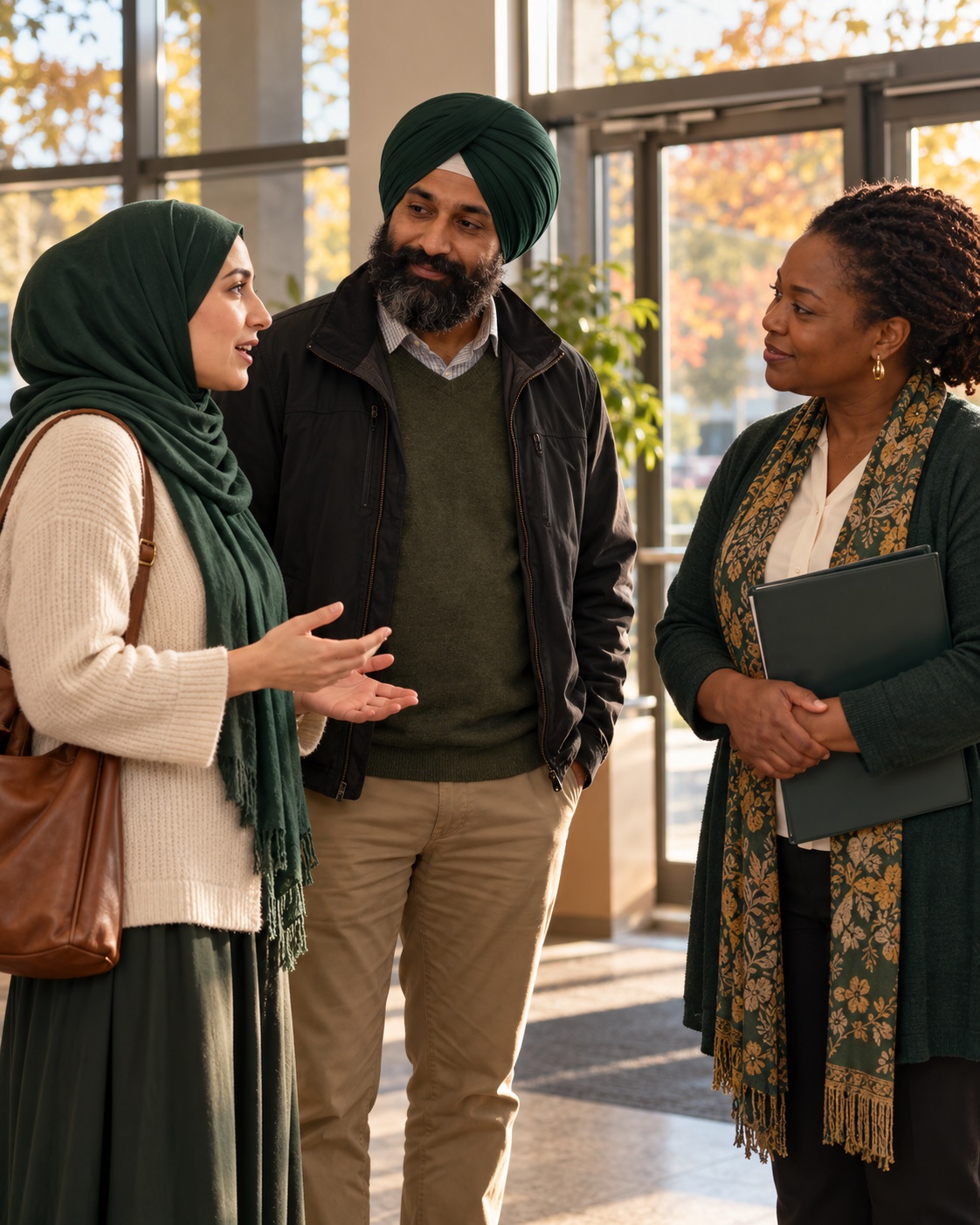
Explore the guideAll three images are AI-generated illustrations, not actual Council activities.
Open the learning hubGlobal
Research on religious dress laws, attacks on worship spaces, public narratives and prevention methods.
A research note members can useNational
Police reported hate crimes, human rights complaints, school disputes and court or policy changes.
A briefing for Canadian partnersLocal
Resident reports shared with consent, school and workplace concerns, site threats and unmet service needs.
A local priority and responseBriefs would need dated sources and human review. Population figures, incident reports and service needs answer different questions and would be kept distinct.
08 / The proposed city network
Each city would choose its own priorities. Councils could ask peers for help, exchange useful tools and adapt what works elsewhere.
Proposed structure and locations. Learning, resources and relationships return to local communities; each community keeps its own decisions.
Illustrative Vancouver council
A 16-seat proposal gives equal space to Muslim organizations and wider faith and community partners. This is an example for discussion; no seats or appointments are confirmed.
Bring your community to the conversationMosques, Islamic centres, social services, youth, women and local communities.
Christian, Jewish, Sikh and other faiths; neighbourhood, service and civic partners, as agreed locally.
Start with people. Check the local reality.
These approximate figures from the October 2026 onboarding proposal help frame questions about community scale. They are illustrative estimates of Muslim religious affiliation, not new Census counts, incident figures, Council participation or measures of service need.
Greater Vancouver and Fraser Valley regional districts combined.
Vancouver and Surrey are included in this regional total.Method in the proposal: 2021 Census religious affiliation multiplied by subsequent population growth, assuming the affiliation share stays constant. City estimates use city boundaries. These scenarios have not been independently recalculated for this website. Baseline: Statistics Canada, Table 98-10-0354-04.
09 / Specialist support
The proposal identifies tools and organizations that could complement local work. Each provider controls its services, eligibility and availability.
These are potential supporting routes, separate from council seats. Listing an organization here does not establish a partnership, endorsement or entitlement to a service.
10 / Taking part
Your involvement can fit your mission, interests and capacity. Start with what is useful now; your role can change as your time and community change.
Use resources or join a learning session.
Meet a peer or introduce a service your community trusts.
Share a tool, skill, space or local insight.
Help host a discussion or shape a shared local priority.
Treat people with dignity. Protect confidences. Be honest about capacity. Take part where you can.
These are choices within one community. There are no fixed hours, mandatory projects or required public endorsements.
Tell us one local need and one strength you can share.
Sign upLet’s begin
Tell us who you are, who you serve and what would help your community.
One signup welcomes individuals and organizations from every faith and background. A person reviews each registration before confirming participation or a role.
Tell us a little about yourself. Yusuf Siraj reviews registrations and will contact you about the next step. Email and WhatsApp will be used while BeeGood is being prepared.